
Where does this price come from? Wallify tells you
By Nicolas Lemielle, Director of DigiWall ·
A salesperson calls: « the quotation comes out at 0.38 euro and the customer tells me he pays 0.35 ». And so the little investigation begins — is it the item record, a price grid, a customer discount, or someone who edited the line by hand? In Wallify the answer is shown next to the price.
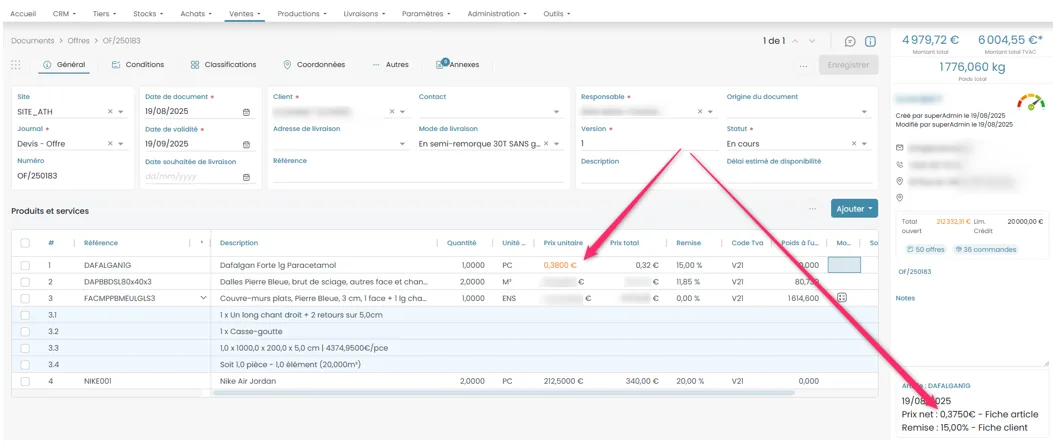
Every price says where it comes from
Hover over a quotation line: Wallify shows the net price and its source, then the discount and its source. Item record, customer record, price list line, calculator — you know which of the four decided, without opening a single setting.
And when someone has changed the value by hand, the price turns orange. The line is not merely correct: it says it has been touched. Wallify draws a logical consequence from that — if the price differs from the tariff, a later recalculation does not overwrite it, because the change is taken to have been deliberate.
Guard rails rather than instructions
A maximum discount can be set per item. If the customer’s discount exceeds that ceiling, Wallify applies the ceiling; and if a user enters an over-generous discount by hand, a message says so and the value returns to its original state. The rule sits in the tool, not in a memo nobody rereads.
Alongside that, an overall discount is entered in the document’s Conditions tab, and some items can be excluded from it — transport or packaging has no reason to follow a commercial discount.
Configuration rather than development
This is the point that matters to a managing director. There is a single Wallify codebase, but a great deal of configuration: price grids, coefficients, discounts by item, by customer or by price list line, settlement-discount exclusions, selling units distinct from storage units. So very particular commercial processes are settled without bespoke development — and what was built for one trade benefits the next, since everyone runs on the same code.
When a rule genuinely falls outside the frame, it is built with you. But we always start by looking for what configuration can already do.

A question on this subject? Our analysts will answer you directly.